What is Meta Ads? Complete 2026 Beginner Guide
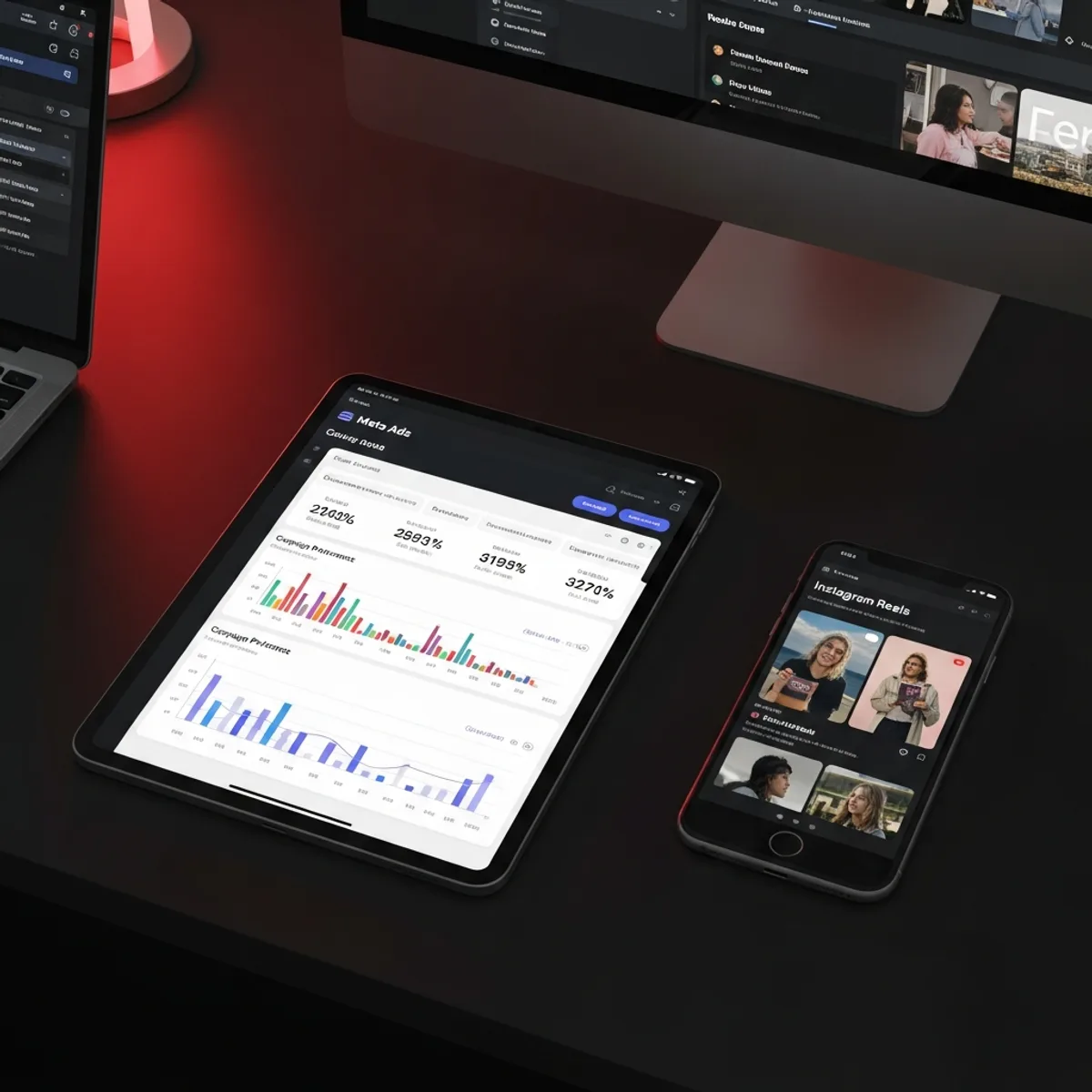
Meta Ads is the unified advertising system that runs across all of Meta's platforms, primarily Facebook and Instagram, with additional reach through Messenger, WhatsApp, Threads, and Audience Network. In 2026, the Meta Ads ecosystem operates through 6 campaign objectives, 6 placement formats, and a standard infrastructure built around Advantage+ automation and the Conversions API (CAPI). Each of these pieces plays a distinct role, and the difference between a profitable account and a wasteful one usually comes down to how well they are wired together rather than how big the budget is. In this guide, I break down what Meta Ads actually is, which campaign type fits which industry, what changed after iOS 14.5, and how to build a ROAS-focused setup from scratch. The aim is a practical map you can follow whether you are launching your first campaign or auditing an account that is quietly underperforming.
What is Meta Ads and Which Platforms Does It Cover?
Meta Ads (formerly Facebook Ads) is the advertising management system operated by Meta Platforms. When Facebook rebranded to Meta in 2021, the ad platform took on the Meta Ads name as well. From a single account, you can run ads across Facebook, Instagram, Messenger, WhatsApp, Threads, and Audience Network. Meta Business Suite (formerly Facebook Business Manager) is the main management interface, while Ads Manager is the module where day-to-day ad operations actually happen. The platform footprint is wide. According to Meta's list of ad placements, on Facebook you have Feed, Marketplace, Stories, Reels, Right Column, and search results. On Instagram you get Feed, Stories, Reels, Explore, and search results. Messenger offers Stories, WhatsApp offers Status, and Threads offers its feed. Audience Network is Meta's ad network for third-party apps. A single campaign can be distributed across all placements automatically, or you can choose them manually.
As of 2026, Meta Ads sits alongside Google Ads as one of the two largest digital advertising platforms in the world. In Turkey it is a core performance channel for e-commerce, services, B2B SaaS, education, and local businesses. Used together in the same campaign, Instagram and Facebook give wide reach for both discovery and retargeting. The real difference shows up in setup quality. On the same budget, a properly configured account and a poorly configured one end up with clearly different return on ad spend (ROAS), because the algorithm only learns from the objective and data it is given.
Meta Ads Campaign Objectives - 6 Types
In 2026, Meta Ads campaign objectives come in 6 types. Meta's page on ad objectives lists them as Awareness, Traffic, Engagement, Leads, App promotion, and Sales. The older Catalog Sales objective now sits inside Sales. The older Conversions objective is split across Sales, Leads, and Engagement depending on the outcome. The objective tells the algorithm who to look for, so the wrong one burns budget no matter how much you scale it.
1. Awareness: Optimized for brand recall and reach. CPMs are low, and expecting direct sales here is a mistake. Critical for new brand launches.
2. Traffic: Optimized for website clicks and page views. Useful for testing landing pages or driving blog traffic. CPC-focused with no conversion guarantee.
3. Engagement: Post engagement, video views, and message starts. Used to build social proof, grow an organic follower base, and start conversations.
4. Leads: Collects leads through forms, messages, or phone calls. You can use Meta's native Instant Form or a website form. A core channel for service-based businesses.
5. App Promotion: Mobile app installs and in-app event optimization. Only relevant if you have a native app.
6. Sales: Optimized for conversion events such as purchase and add to cart. It needs conversion data from the Meta Pixel or the Conversions API to work well. Dynamic retargeting with a product catalog and Advantage+ sales campaigns are built under this objective.
For e-commerce, the Sales objective backed by a catalog is standard. For service businesses, Leads paired with message-focused Engagement works best. For B2B SaaS, the right mix is usually Leads, Traffic, and Engagement. The exact combination should be defined during the audit and strategy phase.
Is Meta Ads the right channel for your business?
Not every product or audience converts on Meta. Let's spend 30 minutes mapping your offer, customer journey and competition - then decide if Meta should be your starting point or a secondary channel.
Book a callPlacement Formats - 6 Core Ad Types
Meta Ads supports a broad range of visual formats. Pairing the right format with the right placement directly affects creative performance.
Single Image: The simplest format. A static visual plus caption and CTA. 1:1 (square) or 4:5 (vertical) ratios are recommended. Ideal for quick creative testing.
Video: The highest-engagement format. 15-60 seconds is optimal. Use 9:16 vertical for Reels, 1:1 or 4:5 for Feed. The hook-bait-CTA structure is the standard script template.
Carousel: 2 to 10 images or videos in one ad. Strong for product catalogs and storytelling. In e-commerce it works as a swipe-friendly format, showing multiple SKUs in a single ad.
Collection: A mobile-first e-commerce format. A hero asset at the top with a 4-product grid below. Best paired with a product catalog and Instant Experience.
Reels Ads: Placed inside Instagram and Facebook Reels. Vertical 9:16 video, 7-15 seconds, with UGC-style creative working best. In 2026, this format has the highest completion rate.
Stories Ads: Full-screen vertical image or video, 5-15 seconds long. Supports interactive features like polls, quizzes, and swipe-up. Drives high CTR for service businesses and B2C brands.
For placement selection, Meta's "Advantage+ Placements" (formerly Automatic Placements) is the recommended default. The algorithm picks the best-performing placement on its own. Manual placement should only be used when there's a specific reason for it, such as a strict industry rule or brand-safety concern.
Conversion Leads and Advantage+ - The Mandatory 2026 Modules
Conversion Leads and Advantage+ sales campaigns are two critical modules of a Meta Ads account in 2026. One optimizes lead quality, the other automates e-commerce sales.
Conversion Leads: A performance goal you select in lead ads. According to Meta's page on performance goals, the ad is shown to people who are most likely to convert after sharing their contact details. It works with both Instant Forms and website forms. The same page says that from April 2026 this goal cannot be selected in a new campaign without a Conversions API integration that sends CRM data to Meta. It suits service businesses that get enough leads but low lead quality.
Collecting leads through messages: Ads that start a chat in a messaging app such as Messenger or WhatsApp instead of a form. For service customers who decide in a conversation, it is a more natural path than a form. It suits beauty salons, consulting, and real estate.
Advantage+ sales campaigns (also referred to as Advantage+ Shopping): An e-commerce-specific automated campaign type. According to Meta's product page, AI automatically optimizes the audience, placements, and budget. It needs a product catalog and clean conversion data to work well. The daily budget should cover enough conversions for the algorithm to learn.
Advantage+ Audience: Replaces traditional Custom Audience and Lookalike targeting with algorithmic audience discovery. The logic is "find broadly" - the algorithm runs at full capacity without being constrained by tight targeting.
Together, these three Advantage modules represent Meta's AI-first direction. You give up some manual control and trust the algorithm more. The expected return is more efficient results, and the condition is clean conversion data.
After iOS 14.5 ATT - CAPI and Aggregated Event Measurement
With iOS 14.5, Apple made the App Tracking Transparency (ATT) prompt mandatory, and CAPI moved to the center of Meta Ads measurement. Users now see a tracking permission prompt in every app. The behavior of users who decline is missing from ad measurement.
Meta's answer to this is the Conversions API (CAPI). According to Meta's definition, CAPI creates a direct and more reliable connection between Meta and the marketing data on your server, website, app, or CRM. Because the conversion event is sent from the server instead of the browser, browser-side signal loss goes down.
CAPI runs in three layers:
- Meta Pixel: The classic browser-side pixel. Still required (especially for Custom Audiences).
- Conversions API: Server-side event delivery. Implemented through Stape, Segment, GTM Server-Side, or a custom backend.
- Aggregated Event Measurement (AEM): According to Meta's definition, a protocol that allows measurement of web and app events from devices on iOS 14 and later. Events sent through CAPI can also be processed within these limits.
Without a proper CAPI setup, the algorithm learns from incomplete conversion data and spends budget on the wrong people. In 2026, CAPI is a core part of any account that takes measurement seriously.
Is your CAPI and pixel setup actually solid?
In a post-iOS 14.5 world, Meta Ads optimizes on incomplete data without a proper CAPI setup. In a 30-minute strategy call we'll review your current account, audit the CAPI health, and map out which approach will lift ROAS in what timeframe.
Schedule strategy callTargeting - Audience Strategy
A solid Meta Ads audience strategy operates in three layers: Cold (new audiences), Warm (engaged users), and Hot (retargeting). Each layer needs its own creative message and its own share of the budget.
Cold Audience: Users who don't know your brand yet. Targeted via interests, behaviors, and demographics. Allocate 50-60% of the budget here. Creative should follow a hook-bait-CTA structure.
Warm Audience: People who have engaged with you on social or visited your website but haven't bought yet. Custom Audiences include Instagram Engagement, Facebook Engagement, Video Viewers, and Website Visitors. Budget share is 25-30%. Lean into social proof and product detail in the creative.
Hot Audience: Users who added to cart, started checkout, or opened a lead form but didn't complete it. High-intent retargeting. Allocate 15-20% of the budget. Use a mix of urgency, discount, and social proof.
Lookalike Audience: Finding new users who resemble your most valuable existing customers. Settings range from 1% (closest match) to 10% (widest reach). Used as a layer that feeds into the cold audience pool.
In 2026, Advantage+ Audience has largely surpassed manual targeting. When the algorithm is left open, it reaches a broader pool and finds its own audience based on conversion signals. Manual targeting still matters in certain industries (local businesses, regulated verticals like legal and finance).
Meta Ads Pricing - 2026 Turkey Budgets
When you advertise on Meta, you carry two cost lines: the ad spend you pay directly to Meta, and the management fee you pay your agency or freelancer. Here are the typical 2026 ranges in the Turkey market.
Ad spend (paid to Meta):
- Small business test: 5,000-15,000 TL/month
- Mid-size active campaigns: 15,000-50,000 TL/month
- E-commerce and growth phase: 50,000-200,000 TL/month
- High-budget scale: 200,000+ TL/month
Management fee (agency/freelancer):
- Freelancer: 5,000-12,000 TL/month
- Specialist and small team: 13,000-40,000 TL/month
- Large agency: 30,000-100,000 TL/month
- Premium / full Conversion Leads and CAPI build: 30,000+ TL/month
CPM (cost per 1,000 impressions) varies by industry in Turkey: 45-90 TL in e-commerce, 60-120 TL for services, 100-200 TL in B2B. CPC averages between 3-12 TL. For service businesses, CPL typically lands in the 80-300 TL range.
Is it worth the investment? The answer depends on your return on ad spend (ROAS) and customer lifetime value. The same budget can turn into profit in a well-configured account and into a loss in a misconfigured one. So the decision comes from your own cost and margin math, not from a single ratio.
Meta Ads vs Google Ads - Which One Should You Choose?
Meta Ads and Google Ads reach users with very different intent. The right choice depends on your industry and your goal.
| Criterion | Meta Ads | Google Ads |
|---|---|---|
| User intent | Discovery | High intent (search) |
| Format | Visual and video heavy | Text and search results |
| CPC | 3-12 TL | 5-25 TL |
| Time to ROAS | 14-30 days | 7-14 days |
| E-commerce fit | High | High |
| Service businesses | Leads and message campaigns ideal | Search and Call ideal |
| B2B SaaS | Discovery and retargeting | Long-tail keyword |
| Local business | Geo-targeting | Local Services Ads |
| Brand awareness | Very high | Low |
The ideal approach is running both in parallel - Meta Ads for discovery, warm audiences, and UGC creative, Google Ads for high-intent search demand. If you have to start with just one at SMB scale, the choice depends on the vertical: e-commerce typically leads with Meta Ads, while service businesses usually win first on Google Ads.
Frequently Asked Questions
Is Meta Ads the same thing as Facebook Ads?
Yes. Meta Ads is the post-2021 name for Facebook Ads. When Facebook's parent company rebranded to Meta, the ad platform was renamed as well. Functionally it's the same system - ads run across Facebook, Instagram, Messenger, and Audience Network.
How do I start using Meta Ads?
Three steps: 1) Create a Meta Business Suite account (business.facebook.com), 2) Add an ad account and payment method, 3) Install the Meta Pixel and Conversions API on your website. After that you build your first campaign in Ads Manager. A proper initial setup takes 8-15 hours and requires solid technical knowledge.
What's the difference between Conversion Leads and the classic Leads goal?
The classic Leads goal maximizes the number of people who fill in a form. The Conversion Leads performance goal looks for people who are likely to become customers after they fill in the form. To do that, sales data from your CRM has to be sent to Meta through the Conversions API. It is the right option for service businesses that get enough leads but low lead quality.
When should I use Advantage+ Shopping?
When you have an e-commerce setup with a product catalog, the Pixel, and conversion events fully in place. According to Meta's explanation of the learning phase, an ad set usually exits the learning phase after about 50 results in the week after its last significant edit. If your daily budget cannot cover that volume, it is healthier to collect data with a manual Sales campaign first.
Can you run Meta Ads without CAPI?
You can, but measurement stays incomplete. After iOS 14.5 ATT and browser cookie restrictions, a browser-only Pixel cannot see some conversions. CAPI helps close that gap by sending events from the server. In 2026, CAPI is not a luxury, it's a standard part of any account that takes measurement seriously.
What does Meta Ads actually cost in 2026?
Ad spend ranges from 5,000 TL to 200,000+ TL per month depending on industry and scale. CPM lands between 45-200 TL, CPC between 3-12 TL, and CPL between 80-300 TL in service industries. Agency management fees range from 13,000 to 100,000 TL/month, with a typical management fee landing at 15-25% of the ad budget.
How quickly do Meta Ads results show up?
Initial conversion signals appear in 7-14 days. Stable ROAS forms in 30-60 days. According to Meta, the learning phase ends when an ad set gets about 50 results within a week. Optimal performance only kicks in once the Pixel and CAPI have collected enough data.
Should I manage Meta Ads myself or hire an agency?
If your monthly ad spend is below 30,000 TL, self-managing is reasonable (assuming you accept the learning curve). Above 30,000 TL, the cost of a wrong setup grows, so weigh the management fee against the spend you are wasting. Above 100,000 TL in monthly spend, an agency or an independent specialist should manage the account.
The right way to start with Meta Ads
You've read the guide - now let's figure out the right approach for your specific situation. In a 30-minute strategy call we'll go through your current setup, your goal, and what kind of result is realistic in what timeframe. No commitments, no contracts.
Book a callMeta Ads in 2026 is far broader than the classic banner ad of the past - Conversion Leads, Advantage+, CAPI, AEM, and a layered Lookalike audience strategy are now baseline infrastructure. The same budget turns into results with the right setup and into wasted spend with the wrong one. The 6 campaign objectives, 6 placement formats, 3-layer audience model, and CAPI architecture covered in this guide are a solid starting point for a from-scratch setup.
You can review the detailed package contents, price ranges, and client outcomes for my Meta Ads agency service on the service page.
Related guides: Instagram Ads Guide 2026 · How to Increase Facebook Ads ROAS · Google Ads vs Meta Ads Comparison · Google Ads Management Guide

Abdullah Çalış
Dijital Pazarlama Stratejisti & Otomasyon Mimarı
Framework odaklı, veri destekli dijital pazarlama stratejileri ve AI otomasyon çözümleri ile markaların sürdürülebilir büyümesini sağlıyorum.
Dijital Pazarlama Stratejinizi Güçlendirin
Framework odaklı yaklaşımımız ile markanızı büyütmek için hemen iletişime geçin.
Strateji Görüşmesi Alınİlgili Yazılar
Meta Ads Manager Guide: Hands-On Tutorial (2026)
Meta Ads Manager from zero to launch: account setup, Pixel, CAPI, campaign creation, audience design, and ROAS optimization.

Instagram Ads: Step-by-Step Guide From Scratch 2026
Instagram ads guide: Step-by-step Meta Ads Manager setup, targeting, format selection, budget settings, and launching your first campaign.
How to Increase Facebook Ads ROAS? Framework Approach
Proven methods to increase your Facebook Ads ROAS with the Growth OS framework. Creative testing, scaling, and optimization strategies.